
5 Signs Your Production Line Needs to Upgrade from Manual to Automated Wrapping
August 3, 2026
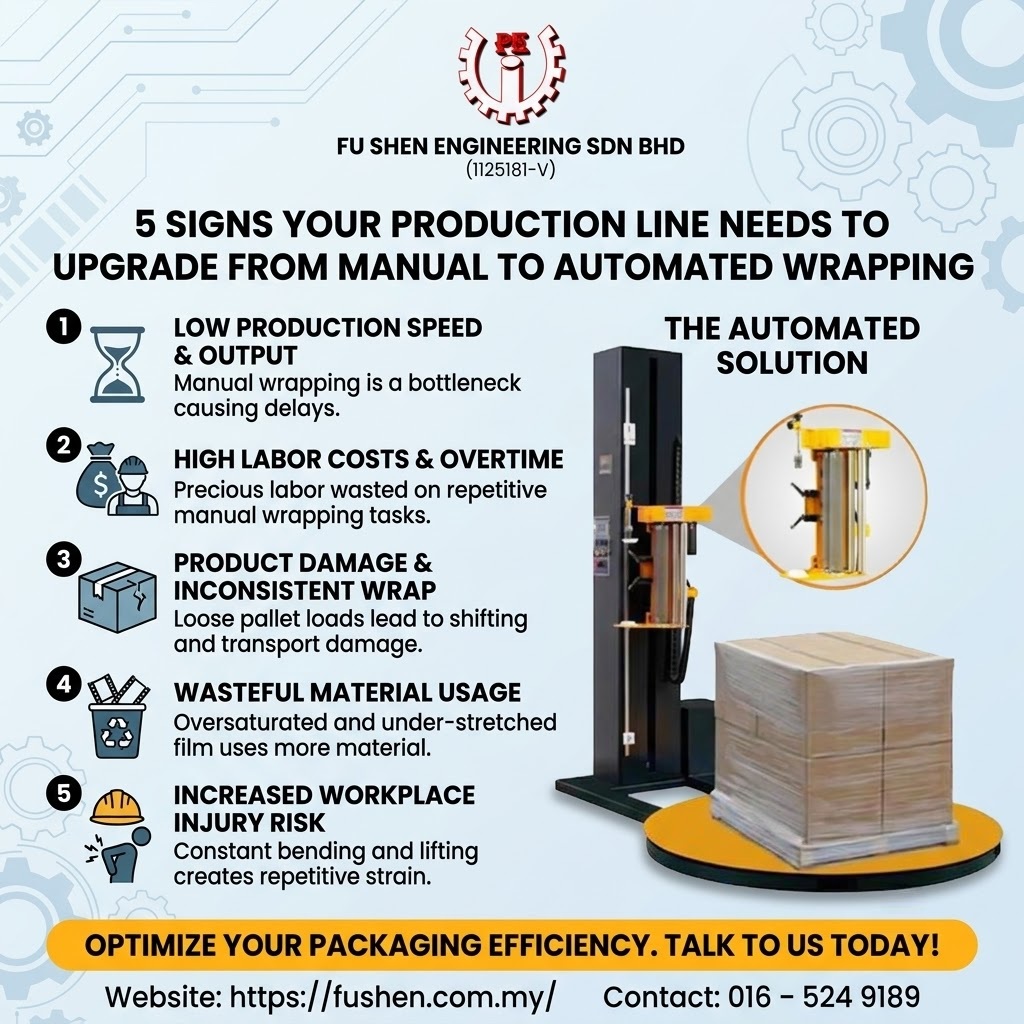
Are you struggling with inconsistent packaging, rising labor costs, or frequent product damage? Discover the top five critical signs that indicate it is time to upgrade to automated wrapping today.
5 Signs Your Production Line Needs to Upgrade from Manual to Automated Wrapping
FU SHEN ENGINEERING SDN BHD is a trusted engineering powerhouse in Malaysia. We don't just build machinery; we engineer solutions that drive industries forward. Specializing in metal fabrication, custom assemblies, and advanced machinery, we are the backbone for sectors ranging from manufacturing and logistics to pharmaceuticals and oil & gas. Visit our website.
The 5 Critical Signs for an Automated Upgrade
1. Frequent Bottlenecks at the Packaging Station
When your manufacturing speed outpaces your packaging capabilities, pallets begin to pile up. Manual wrapping is physically taxing and time-consuming, meaning even the hardest-working team cannot match the continuous output of an efficient production line. If finished goods are sitting on the floor waiting to be wrapped before dispatch, your overall throughput is heavily compromised.
- ➔ Production Delays: High-volume output is wasted if the end-of-line packaging cannot keep up.
- ➔ Space Constraints: Unwrapped pallets take up valuable warehouse floor space, creating tripping hazards and logistical chaos.
2. Inconsistent Wrapping and Load Instability
Human fatigue naturally leads to inconsistency. A worker wrapping their first pallet at 8 AM will apply a different tension and overlap compared to their fiftieth pallet at 4 PM. This inconsistency leads to poorly secured loads, which are prone to shifting during transit.
- ➔ Product Damage: Shifting loads easily result in crushed or broken goods, damaging client relationships.
- ➔ Tension Failures: Inadequate stretching of the film compromises the structural integrity of the pallet profile.
3. Excessive Material Waste (High Film Costs)
Manual wrapping almost always results in higher film consumption. Workers tend to over-wrap "just to be safe" or fail to properly pre-stretch the film, utilizing only a fraction of the film's actual yield potential. Automated systems maximize the stretch potential of packaging films, drastically reducing material usage per pallet.
- ➔ Poor Yield: Manual application generally achieves less than 10-20% film stretch, whereas machinery can achieve up to 300%.
- ➔ Environmental Impact: Higher film usage directly translates to a larger carbon footprint and more plastic waste.
4. Rising Labor Costs and Staff Turnover
Walking in circles around a pallet while bent over to wrap the bottom layers is monotonous and physically demanding. Companies relying on manual wrapping often face high turnover rates in their packaging departments, leading to constant recruitment and training cycles.
- ➔ Inefficient Resource Allocation: Skilled laborers are better utilized in quality control or operational roles rather than walking in circles.
- ➔ Training Drag: Constant turnover means persistent operational downtime as new staff learn the ropes.
5. Increased Workplace Injuries and Ergonomic Issues
Safety should always be a priority. Manual wrapping requires bending to secure the base of the pallet and reaching high to secure the top. This repetitive motion frequently causes back strains, shoulder injuries, and fatigue-related accidents.
- ➔ Repetitive Strain Injuries (RSI): The physical demands lead to long-term health issues for employees.
- ➔ Dizziness & Fatigue: Walking around pallets repeatedly causes dizziness, raising the risk of warehouse floor accidents.
Why Upgrade to Automated Wrapping?
Maximizes Film Yield
Pre-stretch technology ensures every inch of packaging film is optimized, drastically reducing consumable expenses.
Guarantees Load Stability
Programmable tension settings provide a tight, uniform wrap every single time, ensuring goods survive long-haul transport.
Elevates Worker Safety
Eliminates the physical strain of manual wrapping, keeping your workforce safe, healthy, and focused on higher-value tasks.
Where Automated Wrapping is Used (Real Applications)
Our advanced machinery is deployed across highly demanding industrial environments to secure varied product types:
- Logistics & Warehousing: Securing mixed-load pallets for safe distribution across complex supply chains.
- Electronics & Semiconductors: Providing anti-static, secure wrapping for highly sensitive and high-value technical components.
- Food & Beverage: Ensuring hygiene and load stability for bottled liquids and perishable goods during transport.
- Pharmaceuticals: Cleanroom-compatible wrapping maintaining strict compliance and product safety.
- Oil & Gas Consumables: Heavy-duty stabilization for drums and lubricants shipped globally.
Comparison: Manual vs. Automated Wrapping
| Feature | Manual Wrapping | Automated Machinery |
|---|---|---|
| Consistency | Variable; drops as worker fatigues | 100% Uniform and Programmable |
| Film Usage | High waste; poor stretch ratio | Highly optimized; up to 300% pre-stretch |
| Throughput Speed | Slow; prone to bottlenecks | High-speed; continuous operation |
| Safety Risk | High risk of back strain & dizziness | Minimal; requires button operation only |
Installation & Usage Information
Transitioning from manual to machinery is seamless with the right engineering partner. The usage is designed for simplicity:
- Positioning: A forklift or pallet jack operator places the loaded pallet onto the machine's turntable.
- Attachment: The operator attaches the leading edge of the film to the base of the pallet.
- Activation: The operator selects the appropriate pre-programmed wrapping cycle via the control panel and presses start.
- Automated Cycle: The turntable rotates while the film carriage ascends and descends, applying precise tension and overlap automatically.
- Completion: The machine cuts the film (on fully auto models) or signals completion. The wrapped pallet is removed, ready for shipment.
Your Trusted Quality Brand
At FU SHEN ENGINEERING SDN BHD, we don't just supply equipment; we engineer reliability. By focusing on robust fabrication and seamless integration, we ensure that every machine deployed acts as a relentless asset to your production line. Our localized expertise means your machinery is backed by swift, professional support exactly when you need it.
Professional Installation Processes & Techniques
Proper installation dictates the lifespan and efficiency of industrial machinery. Our engineering approach includes:
- 1 Site Assessment & Leveling: Industrial floors are rarely perfectly flat. We utilize laser leveling techniques to calibrate the turntable base, preventing motor strain and ensuring smooth rotation.
- 2 Load Profiling & Sensor Calibration: Photo-eye sensors are strictly calibrated to detect various product profiles, including dark, reflective, or transparent packaging, ensuring the carriage accurately reads the top of the load.
- 3 Pre-Stretch Gear Optimization: Our technicians mechanically and electronically tune the pre-stretch rollers to match the specific micron thickness of your preferred film, guaranteeing maximum yield without tearing.
- 4 Integration: For advanced projects, we integrate conveyor systems directly with the wrapping station, programming PLC controllers to handshake seamlessly with upstream production lines.
Our Primary Service Areas
We proudly engineer and deploy solutions across prime industrial zones:
Bayan Lepas, Batu Kawan, Bukit Minyak, Penang Science Park, Prai Industrial Park, Bukit Tengah, Mak Mandin, Seberang Jaya, Bandar Cassia, Batu Kawan.
Explore More Resources
Client Reviews
"Upgrading our end-of-line process was the best decision. The customized engineering completely eliminated our warehouse bottlenecks. The precision tuning by their team means our pallets are finally stable for export. Highly recommended!"
- Ahmad Zulkifli, Penang Science Park
"The difference in film usage is night and day. We used to waste so much plastic due to poor manual stretching. Now, the machine handles it flawlessly, saving us huge material costs every single month. Brilliant engineering setup."
- Michelle Lee, Bayan Lepas
"Worker safety was our main concern, as our operators were complaining of back pains from manual work. Post-installation, the morale is high, operations are smoother, and the equipment is incredibly user-friendly and reliable."
- S. Ramesh, Batu Kawan
"FU SHEN ENGINEERING provided exceptional guidance. They analyzed our electronics packaging needs and calibrated the sensors perfectly to detect our sensitive shipments. It’s a game-changer for our logistics department."
- Kelvin Tan, Prai Industrial Park
"We transition from manual labor to their automated systems seamlessly. The installation was professional, on time, and they didn’t leave until every single operator understood how to safely run the equipment."
- Siti Nurhaliza, Bukit Minyak
"I was skeptical about the ROI, but the numbers speak for themselves. The structural integrity of our food pallets has improved drastically, completely eliminating rejected shipments due to transport damage. Excellent local support too."
- David Ooi, Seberang Jaya
"Their technical team was meticulous during setup, ensuring the turntable was perfectly leveled on our uneven factory floor. The smooth operation has noticeably boosted our daily throughput without any hitches."
- Lim Wei Chong, Mak Mandin
"A truly reliable brand in Malaysia. The custom fabrication they integrated into our existing conveyor lines was brilliant. It completely automated our workflow from production line directly onto the shipping truck."
- Farah Nabilah, Bukit Tengah
"Outstanding performance. The machinery works non-stop in our demanding warehouse environment. Film tension is always consistent, and our operators love how straightforward the control panel is to master."
- Jason Raj, Bandar Cassia
Frequently Asked Questions
What are the obvious signs that manual wrapping is holding back my production?
The most obvious signs include pallets piling up at the end of the line, frequent complaints of damaged goods during transit, high turnover rates among packaging staff due to physical strain, and excessive plastic film waste compared to industry averages.
How does automated equipment solve inconsistent load stability?
Automated equipment utilizes programmable tension controls and precision-engineered film carriages. This ensures that every layer of film is applied with the exact same overlap and stretch force every time, completely eliminating human error and fatigue-related inconsistencies.
Will upgrading to machinery reduce my monthly consumable materials expenditure?
Yes, significantly. Manual wrapping usually achieves very low stretch yields. By contrast, advanced machinery utilizes powered pre-stretch technology that can stretch the film up to 300% before it touches the pallet, drastically reducing the amount of film required per load.
What industries typically benefit the most from this specific upgrade?
This upgrade is highly beneficial for high-volume sectors including logistics, food and beverage manufacturing, pharmaceuticals, electronics, and any industry where secure palletization is strictly required to prevent transit damage.
How does this technology improve overall warehouse workplace safety?
By automating the process, operators no longer need to walk backward in circles, bend down to secure base layers, or stretch dangerously high for top layers. This practically eliminates repetitive strain injuries, back pain, and dizziness-related floor accidents.
Is the transition and installation process disruptive to ongoing factory operations?
Not at all. Professional engineering teams conduct thorough site assessments prior to installation. The actual setup, including laser leveling and sensor calibration, is executed swiftly and can often be scheduled during off-peak hours to ensure zero disruption to your daily output.
Do operators require specialized engineering knowledge to run the equipment daily?
No specialized knowledge is required. Modern systems feature highly intuitive, user-friendly control panels. Once the machine is professionally programmed to your specific load profiles, operators simply need to attach the film and press a button.
Can the machinery accommodate irregular or exceptionally fragile pallet loads?
Absolutely. Advanced photo-eye sensors dynamically read the height and shape of the load. Furthermore, customized tension settings can be applied to ensure that even lightweight or fragile goods are wrapped securely without being crushed.
Why is proper floor leveling critical during the initial machinery installation?
Factory floors frequently have slight slopes. If the turntable is not perfectly laser-leveled during installation, it creates uneven wear on the motor drives and bearings, which severely compromises the operational lifespan and rotational smoothness of the equipment.
What makes local after-sales engineering support so critical for this equipment?
Having a trusted local engineering partner ensures that if technical adjustments, sensor recalibrations, or structural maintenance are required, expert technicians can be dispatched rapidly to prevent prolonged and costly production downtime.
├── Category: Wrapping Machine
├── The Ultimate Guide to Choosing a Wrapping Machine Supplier in Penang
├── 5 Signs Your Production Line Needs to Upgrade from Manual to Automated Wrapping
├── Eco-Friendly Packaging: How Smart Wrapping Machines Reduce Plastic Film Waste
├── How to Maximize ROI on Automated Pallet Wrappers for Manufacturing SMEs?
├── Inside Fu Shen Engineering: How We Provide Custom Packaging Solutions in Northern Malaysia
├── Solving Packaging Challenges for Penang’s Electronics and Semiconductor Sector
├── Stretch Wrapping vs. Shrink Wrapping: Which Machine is Best for Your Factory?
├── The Ultimate Maintenance Checklist for Industrial Stretch Wrapping Machines
├── Why Local After-Sales Support is Critical When Buying Packaging Machinery in Penang?